
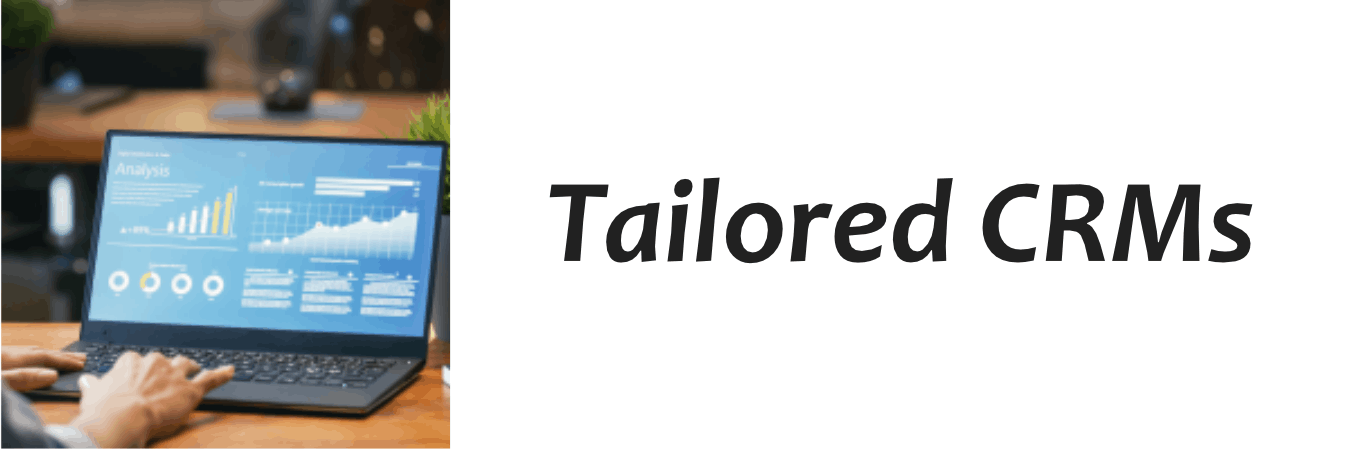






"He rebuilt the layout for our Zoho CRM to assist us in moving off of paper and try to bring better alignment between the needs of separate business units... promoting cross-functional collaboration and maximizing our return on our human capital."
When companies make technology purchases, the vendor generally has preconceived notions about optimal operating structure for peak performance.
They're not altogether wrong, as these concepts are usually grounded in hard data.
Your company may not fit their mold, as every organization is unique.
Differences in tech stack and business strategy can generate very different outcomes after integrating the same tool.
I started my career in tech selling CRM and ERP solutions in the highly regulated P&C insurance space.
The composable and comprehensive nature of our offering provided me with unique experience in gauging product collaboration.
Our suite was thirteen total programs that could be pieced together to create two ERP systems and a CRM.
Scoping complicated adjustments to workflows became routine.
What works best for a group of 20-somethings that are tech-forward and automation-reliant, may not suit more process-driven or experienced business units.
Let's say you have an absolute all-star in operations named Debbie.
She is 60-years old, has all the tribal knowledge, and your company could not operate without her.
She is not likely to perform her duties (or even want to perform her duties) the same way as Jack, your digital native recent graduate.
He knows tech, but is only learning the ropes of how your company operates.
The two have a different mindset towards and relationship to technology, plus how it should be leveraged in their day-to-day.
"He rebuilt the layout for our Zoho CRM to assist us in moving off of paper and try to bring better alignment between the needs of separate business units... promoting cross-functional collaboration and maximizing our return on our human capital."
Proper workflow optimization requires:
Concessions to learn new things usually need to be made on all sides, with a mutual respect for how people are able to work.
With a clear picture of the quantity of work that needs to be accomplished for the organization to hit its KPIs, success is usually attainable.
Risk mitigation is generally a top priority, as well.
I have experience working with executives and ownership to weigh exposure against operational initiatives when codifying procedures.
I've worked with mature organizations that are scaling and need to solve this puzzle with minimal disruption to operations.
I've also worked with startups who have the luxury of gameplanning, organizing, and testing various strategies to maximize operational efficiency.
Every situation is unique based on what the company needs to accomplish.
If you know you're not seeing the ROI you should, or are gearing up to scale, it's important to speak with someone who has seen how these situations can play out.
You wouldn't plan on growing your family by just saying "we'll figure it out."
Why should you approach your business any differently?
Whether you're a startup, or preparing to tackle new challenges with a mature business, contact me and let's chat about what you are trying to accomplish.